
BBC News in-line text links trial out in the wild
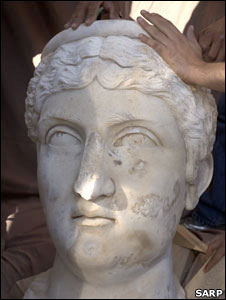
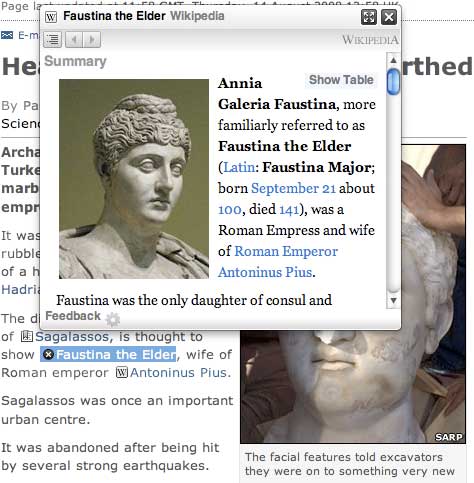
I had my first brush with the BBC News trial of inline text links today - on a story about the discovery of a giant classical statue's head in Turkey.
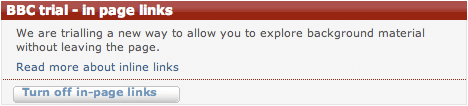
To see the trial, you need to select to 'turn on' the links from an options panel that is embedded a little way down into the story.
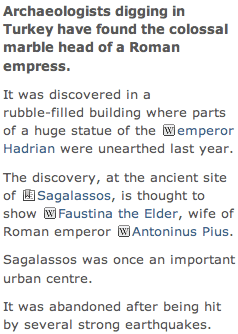
The links then appear within the body of the text, preceded by a small icon - 'W' marks a Wikipedia link, a 'bookmark' icon indicates links to elsewhere.
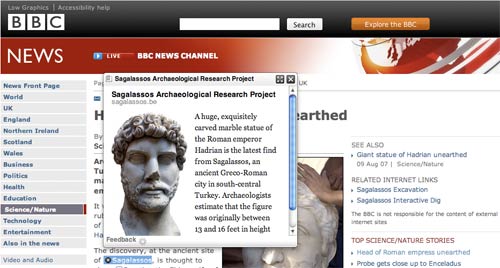
The content opens up in a pop-up overlay on top of the BBC News site, and the system is provided by Apture.
According to the help page accompanying the trial:
"We are doing this trial because we want to see if you enjoy exploring background material presented in this way. It's part of our continuing efforts to provide the best possible experience.
In addition to background material from the BBC News website, we are also displaying content from other sites, including Wikipedia, You Tube and Flickr. We have done this to find out what you think about us offering you related material from other sources."
In truth, I suspect the motivation is due to the dim view taken by the BBC Trust earlier this year of the BBC's efforts to link out more widely from bbc.co.uk. Personally, I'm not entirely convinced that littering the web with yet more links to Wikipedia as the standard definition for everything does much to aid the BBC's role to be a 'trusted guide' to the web.
But then, as I've written before, I'm not convinced that either the BBC or the BBC Trust understand what that actually is anymore.
Hey Martin
I would agree that linking through to Wikipedia alone doesn't particularly help move things forward - but that's not the point. Apture can be used to bring context from many different sources, and we're hoping to expand the system to allow anyone to plug their reference sources into Apture.
I'm pleased you're otherwise positive about it - I've been working with the Apture guys for a few months now, and I'm really excited about the product.
Hope all is well,
This is ever so strange. The thing that made the web so different -- and caused it to boom to fast -- compared to other information systems on the internet, was the fact that it was built around hypertext. Right from the very beginning, you've been able to embed links to another site into your web pages, and I'm not quite sure why News Online felt they had to invent a whole new Javascript-based pseudo-popup way to handle links, rather than using the venerable <a> tag.
Admittedly the eye-candy factor is fairly high, but it totally excludes anyone who isn't using Javascript on their browser, and I suspect it bamboozles screen-readers and the like, too.