
Quadraphonic: The forgotten surround sound of the 70s
Yesterday, when I was writing about the aborted attempt of the music industry to put some kind of copy-protection system into vinyl, I mentioned in passing an old friend of the family, who had hoped that his decoder gizmo to bypass the system would make him rich. He was also the only person I ever encountered with a Quadraphonic sound set-up.
Quadraphonic is the forgotten surround sound system of the 1970s. It was never a huge commercial success, in part because the required equipment was expensive, in part because of myriad conflicting formats, and in part because of the limited availability of any albums apart from those by the Allman Brothers Band in the format.
When I worked in the rarities department at Reckless, we used to automatically get any quadraphonic album that was sold into the stores to sell via mail order. We had a select band of quad-buffs on our mailing list who would basically buy any album in that format. I guess if you've managed to preserve a working quadraphonic set-up, it would be nice to have something new to play on it from time to time - whatever it was.
The competing formats of quadraphonic sound contrived, like the modern day recordable DVD format war, to have almost identical names - CD-4, UD-4, Q4, Quad-8 and my favourites - the completely different QS and SQ systems.


On reel-to-reel cassette or 8-track cartridge it wasn't so hard to provide 4 discrete channels of audio. On vinyl, however, the trick was to encode the four channels into the groove and then use a mathematical matrix formula to decode the four elements of the signal.
That meant extra equipment, carefully set up record players with more sensitive cartridges and stylii, and having to press records on better quality vinyl.
Some of the ideas behind particular versions of quadraphonic seem particularly baffling. The CD-4 format, for example, encoded the information that allowed the 4 tracks to be separated in the inaudible 18 to 50 kHz range. Which would be fine, except for the fact that if you've ever heard the muddy sound of an over-played vinyl record, you'll know that it is the top frequencies that are eroded by play the fastest. The high frequency carrier signal was almost certain to be unreproducable after a half-a-dozen plays of an album, leaving the buyer with a very expensive record with wobbly stereo.
Tab Patterson appears to be the world wide web's leading expert on quadraphonic sound consumer equipment. He has some neat animated gifs illustrating the way decoders split the signal into four.
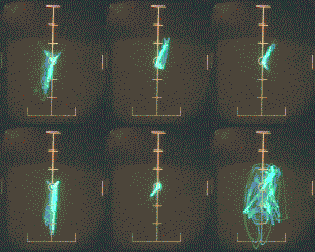
He also has a great selection of pictures of vintage quad decoders.
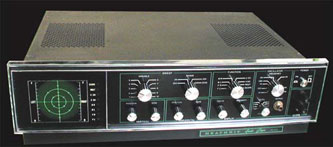
It is interesting to note that just being able to split records up into four channels wasn't good enough for most manufacturers - they also had to have some display to illustrate what was going on as well, whether it was VU meters or a Tomorrow People-style visual scope.
Tab's site also has a letter from Cai Campbell suggesting the CD-4 format I rubbished above wasn't all bad:
Here's a bit of trivia for you about CD-4 records. What you say about high-frequency deterioration in vinyl records is true, which is a definite drawback to the CD-4 carrier signal approach. To account for this, JVC invented "super vinyl" which produced stronger, more resilient "walls" in the grooves on the record. All Quadra disc recordings were to be manufactured with this "Super vinyl", but my guess is that not all were (who knows how to tell?) Anyway, this is the same vinyl formula that Mobile Fidelity Sound Lab used for their first Original Master Recording releases! Cool, huh? Anyway, audiophiles love the Quadra disc issues, not necessarily for their quad content, but because of the superior vinyl resulting in superior sound.
I've seen it claimed on the web that Pink Floyd mounted the first quadraphonic concert on May 12th, 1977. That seems a little late to me, given that the format was introduced at the start of the seventies, although I guess the live environment was a complicated arena to master. These days Super Furry Animals are the only band I've ever seen to put a whole surround-sound show on, although I also recall Pet Shop Boys doing some weird quad thing with their track 'Sound Of The Atom Splitting' at Wembley Arena in the 80s during a costume change.
The BBC also apparently dabbled with quadrophonic sound broadcasts on Radio 3 and 4. It seems a Cliff Richard concert was broadcast this way as well. To be honest, I thought that for most of the 70s, pop music on the BBC barely got stereo coverage (Radio 1 was restricted to Medium Wave frequencies then), and the most adventurous thing was the Sight and Sound simulcasts between TV and radio. There are a couple of BBC research papers about quadraphonic sound from the 1970s available for download on the web.
- "The subjective performance of various quadraphonic matrix systems" - November 1974
- "Quadraphony: Developments in Matrix H decoding" - February 1977
Incidentally, the early Red Book specification of the Compact Disc in 1980 suggests that it was originally intended to be able to carry quadraphonic sound:
"Number of channels: 2 and/or 4 simultaneously sampled. In the case of more than two channels the encoder and decoder diagrams have to be adapted."
Tomorrow I'll be looking at another obscure 1970s vinyl format - RCA's Dynaflex.
I think it was Tubular Bells that I once saw a quadrophonic version of in a shop. It had a sticker on the back which proudly proclaimed:
"Quadrophonic sound - for people with four ears"
I've got the "Mike Oldfield Boxed" collection on Vinyl. Each disc in the 1974 collection is marked "Stereo/SQ Quad Compatible".
I am looking to buy an album- yet I cannot come up with an exact name or title, but I believe it had quadraphonic in the title. As a kid,in the 70's my dad used to play this- for lack of a better term "sound test album". It had all kinds of strange sounds to test your stereo system. Some of the things I recall was an elevator, a band, a very high frequency noise. I believe it was sort of narrated by a male sort of describing what type of sound was going on. ANYONE with ideas what this might have been? Thank you. I have searched for months and cannot come up with any search engine info that turns up any correct response. p.s. Funny test below!
The info about Pink Floyd staging quad in 1977 ( ! ) must be the typo. In their live performances they had the system already in 1967. No doubt about that, you only have to look for "Games For May". And I know that there were quad versions of their Atom Heart Mother album, which was released in 1970. Not to mention Dark Side (1973) and Wish (1975).
Btw. In the days, the BBC related Decca company was quite active a propos quad in classical music. One of the finest projects was 'The chamber music' box (with some 4 or 5 LP's or so; can't recall the exact title, though) to celebrate Arnold Schoenberg's 100th anniversary in 1974. Sheer magic.
Would you happen to know where I might obtain (or rent) a copy of the vinyl quadrophpnic test record (PQX-1011) for the set up of a Pioneer QD-240 CD-4 demodulator ?
The assertions about ultrasonic engravings on CD-4 records being destroyed within a few playings
is simply untrue and is an oft repeated false canard left from the quad days in the seventies. It was
an attempt by matrix proponents to ruin CD-4 chances in the marketplace.
This claimed wiping out of these engravings is unfortunate because it is the most frequent excuse
of quad enthusiasts to not attempt a CD-4 system.
I, and many others, have many CD-4 records which retain their carriers after many playings.
Certainly as many, or more, playings as regular two channel records.