
Managing 'Glue' at the BBC: Introducing the BBC - part 1
This is page 1 of a 5 page article - 1 2 3 4 5
 Download a print version of this article
Introducing the BBC
I wanted to start by giving a bit of context about the BBC. Everyone in the UK who owns a television has to pay a TV Licence every year, of around €180, and all of that money then goes to fund the BBC. There are a lot of televisions in the UK, and so that gives us an annual budget of around €4.5bn, which is an awful lot of money to spend. The BBC now has 8 television channels in the UK, 10 national radio networks and over 50 local radio networks. Increasingly more importantly, and where I come in, since the mid-90s we've been making a website that now has over 2 million pages, and is one of the most visited in the UK.
Now I don't want to frighten you with the next diagram...
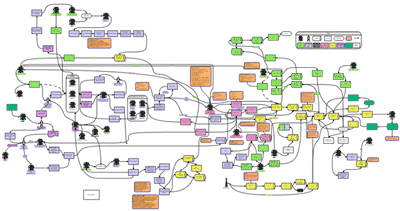
...I'm not going to attempt to explain it - in fact I'm not 100% sure I understand it myself to be honest - but this is a process flow diagram of how the BBC makes bbc.co.uk. I'm one of the stick figures on the left-hand side, and on the far right is someone using the website. I use it to illustrate how complicated the BBC website is, because this is just the process map for ONE department.
There are many departments within the BBC, some producing particular genres of content, like documentaries or programmes for children, and we have some departments that focus on specific broadcast media like television, radio or new media. Each of these groups also have their own teams making their own websites. You can therefore see there are a huge number of people involved.
Unsurprisingly given the size of the organisation and the breadth of the content, the content on the website tends to be organised in such a way as to mirror the organisation of the BBC. I have often said when doing presentations, if only everyone in the UK could learn the organisational chart of the BBC and understand it, then we wouldn't have to bother with putting any structure onto the website that made sense to the user!
To give you an example, consider a documentary programme and complimentary website about Gardening. The site might be made by our talented interactive Factual & Learning department. Or, if it was a programme on the radio not the television, it may appear on bbc.co.uk in the factual genre made by the Radio & Music department. Or, then again, if it was a programme specifically about gardening in the climate of Scotland it may have been produced by BBC Scotland as part of the Nations & Regions groups, and correspondingly appear somewhere under the top-level directory bbc.co.uk/scotland. Or, as the BBC increases the amount of programming made by independent production companies on television from 25% to a quota of between 25% and 50%, it may not have been made by the BBC, and the supporting web content might not even be on bbc.co.uk at all.
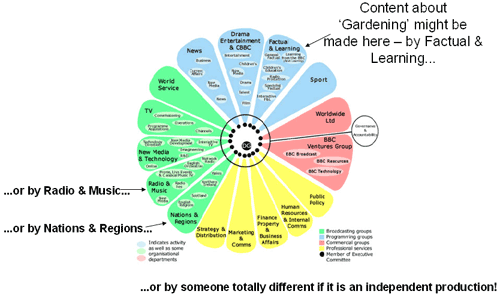
This of course gives the BBC a huge issue in organising this information in a way that the audience can actually find it, which, after all, should be the main goal.
So I want to talk about 3 things that the BBC does centrally to try and make this easier for the end user - navigation, search, and classification.