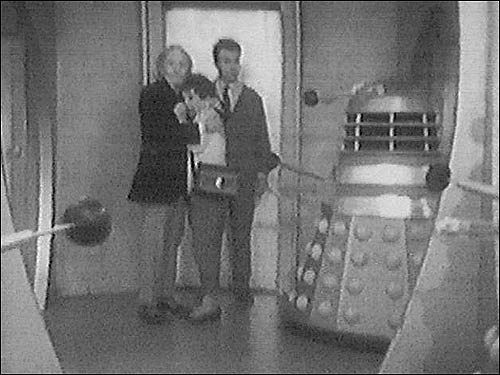
The BBC Radiophonic Workshop in The Guardian's archive
Earlier this year I was lucky enough to have the chance to see some of the surviving members of the BBC Radiophonic Workshop play live at the Camden Roundhouse, and to attend a question and answer session with them beforehand.
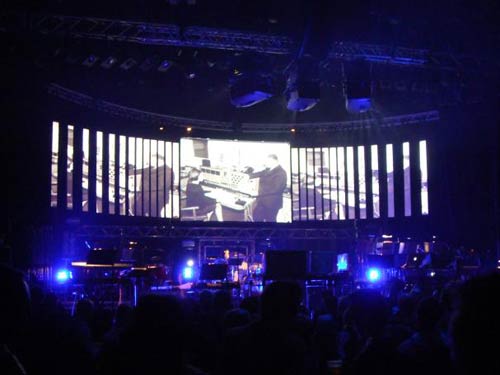
Photo by Stickpeople
Almost certainly the biggest impact the BBC Radiophonic Workshop had on popular culture was Delia Derbyshire's electronic realisation of the Doctor Who theme. However, that didn't hit the nation's screens until 23rd November 1963, 46 years ago today, and 5 years after the workshop was founded. I wondered if anything had drawn the public eye to this band of sound alchemists earlier, and so I had a dig around in The Guardian's digital archive.
I think Ian Rodger, for example, would have been very surprised to have seen members of the workshop alive and well and playing gigs in 2009. In 1962 he declared in The Guardian that:
"The great era of experiment which began with the exploration of the aesthetic possibilities of electronically produced sound now seems to be drawing to a close"
In fairness, his point was not that there was no future at all in the radiophonic sound, but that he was tired of over-use of the 'novelty' of electronic sound effects in radio drama
A lengthier piece extolling the virtues of the Radiophonic Workshop in The Guardian dates from March 1962, by Mary Crozier, entitled "Engineering Music". She opens by saying that:
"For several years, whenever I have seen the name of the Radiophonic Workshop in the BBC's productions, I have pricked up my ears. Though I don't hear as many programmes as I should like, because I see so many."
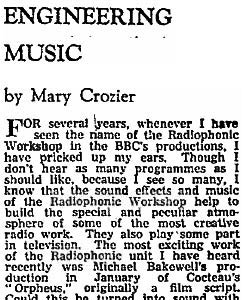
Crozier visited the Maida Vale base of the Workshop, and interviewed Desmond Briscoe:
"Desmond Briscoe, the head of this alchemist's chamber, told me that of the seven people in the workshop, half (three and a half? Special radiophonic fractions?) are engineers. The unit is unique in its engineer-musicians. To manipulate sound needs both technical instinct and dramatic and musical ability."
She concluded:
"The apparatus is much more prosaic than the product. The filter changing white noise to pink noise is more like a laboratory piece than the poetry it can help produce. I left the engineer-musicians among their miles of delicate thin tapes, thinking of Desmond Briscoe's reminder that it is easy to be unpleasant in manipulated sound, but more difficult to be beautiful."
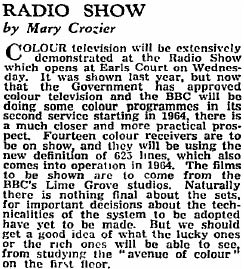
We think that we live in a muddled-up converged media landscape at the moment, but in 1962 the Radiophonic Workshop cropped up again in a Guardian piece. This time they were putting on an event as part of the Earls Court Radio Show. The main attraction at the Radio Show that year was the demonstration of colour television.
In 1963 the workshop was name-checked by The Guardian's regular radio reviewer Anne Duchene. Having been underwhelmed by a new sound effects laden play by Giles Cooper, she was rather more enamoured of the sound effects on children's radio.
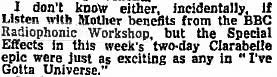
Finally, in September 1963, Mary Crozier again made reference to the Radiophonic Workshop's television output, providing 'clever' sounds during the 'gripping' climax to Nigel Kneale's "The Road". She opened her review by stating that:
"Great expectation must be aroused by the prospect of any play by Nigel Kneale. The Quatermaas serials were really the peak of science fiction; anything else on those lines has only been a pale shadow."
Little was she to know that in only a couple of months time, Doctor Who, the Daleks, and the inspired Radiophonic Workshop sounds that accompanied them, were about to hit the small screen for the first time.