
Is this evidence that Google hand-edits 'sitelinks' for small sites?
A few days ago Search Engine Journal published an article by Ann Smarty where she tried to reverse engineer the algorithmic decisions that lead Google to display a selection of up to eight sitelinks under a search result.

She identified 6 potential theories. As ever, when dealing with the black box that is Google's SERPs, it is a mix of speculation, evidenced-based logic, and extrapolation from Google's published FAQs and webmaster guidelines. The 6 elements Ann mentioned were:
- Surfers oriented
- Domain-authority oriented
- Internal-architecture oriented
- On-page SEO oriented
- Brand-strength oriented
- Competition oriented
Evidence of Google hand edits to sitelinks?
When I started assessing the site links that appear for my site against Ann's criteria, I noticed something strange. Something that began to make me wonder if Google hand-pick, or at least hand-edit, the sitelinks that appear. You see, the link titles given in the SERPS by Google differ from those on my original HTML article titles.
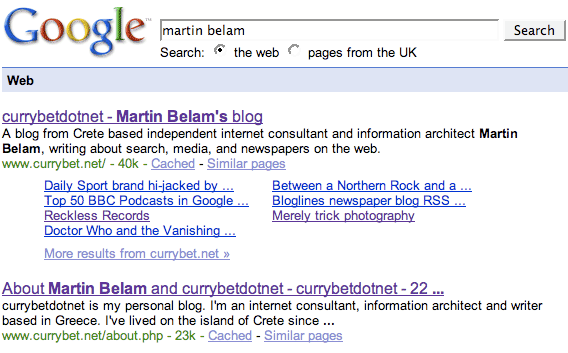
My piece 'Merely trick photography?' becomes 'Merely trick photography'. OK, it only drops a question mark, so maybe that is just Google throwing away punctuation.
A more significant change occurs with the link that Google gives as 'Bloglines newspaper blog RSS...'. The original HTML title of this article is 'Newspapers 2.0: Bloglines newspaper blog RSS subscription figures'. Dropping the 'Newspapers 2.0' part of the title seems a more deliberate ploy.
The biggest change is with the first part of my lengthy series about when I used to work in second-hand record shops in the 1990s. 'Reckless Records RIP - Part 1: An End Has A Start' becomes just 'Reckless Records'.
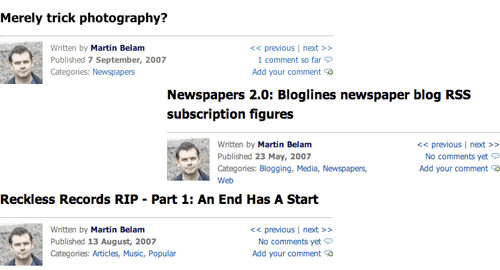
It may be that inbound link anchor text has played a part in changing those titles. However, the fact that the changes made vary, yet continue to make sense, suggests there may be some human manipulation to me.
I very, very much doubt this is happening by hand.
As a rule, Google will find a automated solution to a problem rather than a manual one. This is mainly down to the scale of the datasets they are playing with. What would happen with multiple languages? What happens when your sitelinks change?
Best to have one *very* clever Googler code something and utilise all those computers than have thousands and thousands of multi-lingual sitelinks operatives toil day and night.
I don't think that's evidence at all - just a clever algorithm!
See Matt Cutt's video - he talks about Sitelinks at about 7:15.
Thats very interesting,
I do believe that inbound link anchor text has a play in this, many links with same anchor text making a site an authority on the subject.
Have seen lower PR sites with sitelinks too, like official sites of less known popstars.
It does make you wonder how google does this, sounds most likely to be a clever algorithm but wouldnt be surprised if its done manually by google to some degree.
I understand that human input reduces the system's scalability, but what intrigues me here is that Google once set these 7 links up as my 'sitelinks' months ago and has never changed them - and no measure of inbound links, traffic or internal linking marks them out to be anything special. It can't be that clever an algorithm, these are not very helpful results!
We had six sitelinks on backupanytime.com which showed up for searches "backupanytime", "backupanytime.com" and "Irish online backup"
They may have been presented for other terms but these are the ones I discovered. Anyway, I felt at the time that two of them while containing relevant content to specific online backup search queries were not appropriate to general online backup queries. I removed them. No other site links replaced them. Next I decided to narrow it down to three sitelinks which are main links from the home page. I felt that if I only retained sitelinks which were strong pages of authority that Google may replace the removed ones with other strong pages of authority. Now months later I still have the three retained links and no replacements for the removed ones. I am at this stage considering taking back the ones I removed. Any advice appreciated...
John