
Making the most of blog comments: Part 9 - Future blog comment interfaces
I've been writing a series of posts looking at the way that comments are implemented on blog sites. This week I've been concentrating on some of the usability and interface issues with the process.
The blog comment format is a well established model on the Internet now, but it is also quite a constricting and linear one. I've been thinking about some ways that the next generation of blogging platforms may be able to improve on the model.
The kind of idea that I have in mind not only facilitates conversation, but also allows for 'annotation'. I see it as a mix between post-it notes, a wiki, and the tradition of exegesis applied to sacred texts.
What I'd like to see is the ability, when visiting someone's blog, to grab a chunk of their text, and post my reply directly to that point.
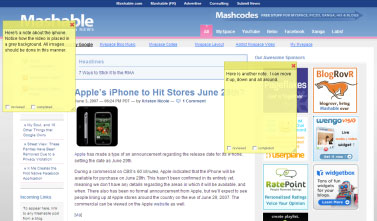
In fact, there are several models for this kind of interaction on the Web already. Protonotes, for example, is one attempt at this.
Another way that this model could evolve would be to follow the way that TheyWorkForYou handles the annotation of Parliamentary speeches. Here, although each 'article' is in fact a long Parliamentary debate, it is made up of lots of smaller speeches. The 'atom' of content that can be annotated is each contribution by a single speaker.
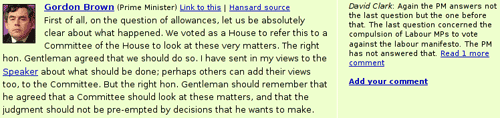
To carry this model over to a blog, each blog post would consist of a series of 'atoms' of paragraphs and images, and the user would then be able to add a comment to each 'atom'.
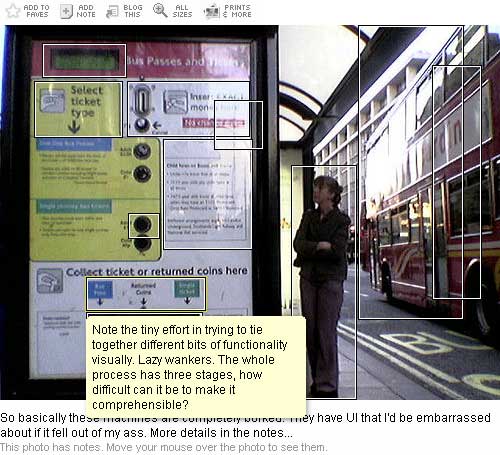
Another example is the way that people can add notes to photographs on Flickr. Providing they have given prior permission, not only the person who uploaded the picture, but visitors to the page can draw notes onto a photograph.
Probably the most densely notated photograph I've seen on Flickr is Tom Coates' "London bus ticket machine, plus bus and bus user (to help explain the whole arcane process)""
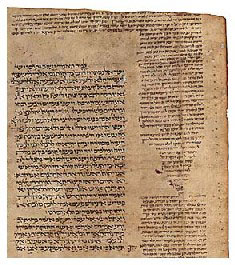
In all, these mechanisms remind of the tradition of Biblical Exegesis. A sacred text would be faithfully copied, and around the margins of the page scholars would write explanatory and philosophical notes. Then at a later date, the book would be copied again, and this time new notes might be added to clarify the earlier annotations. These works became an evolving document, helping the religious flocks of the time understand a distant original message.
I love the idea that this kind of interaction model could allow blog posts to develop into an unfolding text, instead of being one inert slice of content, followed by some linear and chronological reflections.
Next week...
Next week I'll looking at some practical issues around hosting comments on blog sites - how to handle awkward users and comment moderation, and how comments can also help you defuse difficult situations and complaints about your blog.