
Gaining Online Advantage: Understanding online business models - part 4
This is page 4 of a 13 page article - 1 2 3 4 5 6 7 8 9 10 11 12 13
 Download a print version of this article
Understanding online business models
Earlier during the Gaining Online Advantage conference Ross Jenkins outlined some of the different business models you can have on the web. Being accountable or allowing people to make a complaint, these are examples of the kind of self-service business model, where the BBC is able to save money by channelling all complaints about any programme or service through one communication channel.
Equally the BBC exhibits the lead generation model, where the BBC is getting the audience involved in their programmes, or getting users signed-up to message boards, games and other interactive services, where the BBC has something like nearly two million registered users.
Although the public service area of the BBC doesn't have a specifically e-commerce model, it does have a mixture of business models operating across the bbc.co.uk site, and other parts of the BBC family, like the BBC Shop, do carry out commercial transactions online.
You need to decide which of these models your website is going to address, and how you make that meet with your strategy.
Branding your organisation on the web
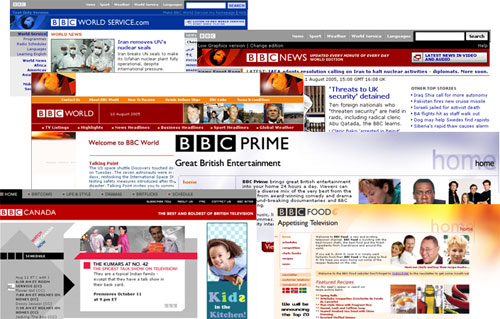
The BBC, like many organisations, is very concerned about how the BBC brand is promoted and perceived. In the UK the scrabble-tile style letter logo is one of the most recognised brands in the country. The BBC tries across the site to get a model of consistency in the way the brand is presented to the audience. This isn't just a UK issue though, the BBC also has a huge global brand presence, particularly in the sphere of news. There are a large number of BBC sites that are not found at bbc.co.uk, like BBC America and BBC Japan for example.
However across all of the properties you find very similar branding, with the three letters in their squares normally in the upper-left of a page. Although the sites do not all look the same, you can see that the sense of the BBC brand as a whole is very strong.
This article continues by looking at some of the ways the BBC uses navigation and search as a way of bringing together the publication of a large and diverse organisation into a single web entity, and looks at differing approaches to internationalisation and localisation on the web.