
Analysing The Software That Uses The BBC Homepage
I've just published an article looking at the type of browsers and operating systems used by people to access the BBC homepage. It started out when I tried to answer the casual question "How many people use Firefox to view the BBC homepage", and evolved into a statistical analysis of 32 million requests made for the BBC homepage in the space of one week during September 2005.
I was looking at the user agent string submitted by those requests, which usually reveals the name of the browser and the version of the operating system it is running on.
There are no great surprises in the findings - Windows and Internet Explorer are dominant as you'd expect, but the answer to the initial question was that Firefox has a 9.7% market share amongst users of the BBC homepage.
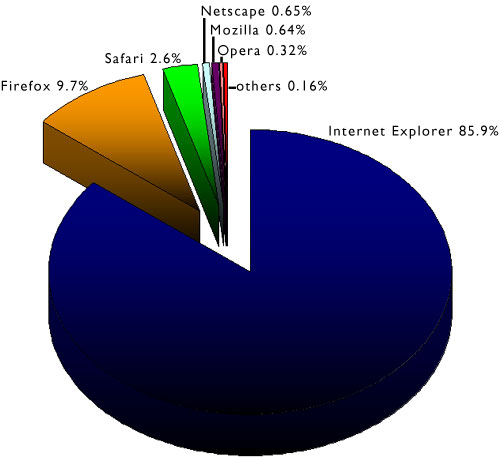
You can find the full article here - The Software Used To Access The BBC Homepage.
Martin,
This was a very interesting writeup. I've looked at my logs, and yea, some real oldie, but goodies out there (I also see Windows 3.x, and have seen Netscape3). I didn't see you mention it, but semi-entertaining is the spoofed User Agents/OS's that people stuff in - some are pretty funny.
I've put some misc. data out there for my piddly web site - see:
http://www.komar.org/faq/slashdot-effect/
but it was facinating to read an analysis of data from the BBC - thanx for sharing!
alek
*** How to do UA detection for Netscape 8 ***
Netscape 8 differs from previous versions of Netscape, Firefox and Mozilla browsers in that it uses *two* rendering engines: Gecko *and* the embedded IE rendering engine. The UA string will change depending on which rendering engine is being used.
In Gecko mode, it could look like this:
Mozilla/5.0 (Windows; U; Windows NT 5.1; en-US; rv:1.7.5) Gecko/20050923 Netscape/8.0.4
Whereas in IE mode it would look more like this:
Mozilla/4.0 (compatible; MSIE 6.0; Windows NT 5.1; SV1; .NET CLR 1.1.4322) Netscape/8.0.4
Many sites are mistakenly tracking "Netscape 8 in IE mode" as just IE, and attributing the hits to IE. Depending on how you are parsing the UA string, this could affect your numbers.
This is just the BBC homepage? If so these are surely not regular BBC site users. I have bookmarks to the whatson, radioplayer, and messageboards, but I don't visit the homepage much.
Dave
>> This is just the BBC homepage? If so these are surely not regular BBC site users.
Well, they troop up in their millions every week - this was looking at 32 million requests made in the space of 7 days.