
Bigger isn't always better with search results
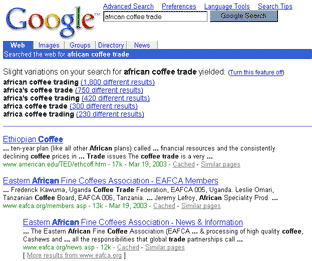
Paul Hammond pointed me at this idea of a 'Better Google' from 37signals. it struck me that it isn't too dissimilar from services already offered by a couple of lesser-used search engines.
Teoma has often been touted as a potential 'Google killer', and in the right hand column of its results set it "auto-magically" lists 'resources' related to the search. These are sites that would be seen to be good starting points for research on a subject, as they are intended to be subject specific and link heavy. The other set in the right-hand margin are suggestions to 'refine' or narrow your search. These seem to have an advantage on the 37signals option, as they look to be taking some context decisions, rather than just stemming or un-stemming individual words within a search string.
Meanwhile Altavista Prisma offers the option to refine your search by adding related categories as an exact phrase match to your search, or to replace your search entirely with a related phrase.
The thing that interested me is that in the model presented by 37signals, they have ranked the alternatives by number of results found for that 'adjusted' or 'slight variations' search. And I think that shows they have bought into the oldest myth in the book, that 'bigger is better'. I don't necessarily believe that getting more results for a search makes it a 'better' search. I concede there are some cases where this is true, for example, if you only get 320 results for 'isreal' and 320,000 results for 'israel', its a pretty good hint that the search query contains a spelling mistake or a non-standard spelling. The chances are that the larger result set will have better sites at the top of its list.
But for the majority of correctly spelt searches, a more useful way of employing this model is to display a summary of the top results for the closely related searches. This allows the user to judge by the quality of the results themselves, not by the quantity. I appreciate there are issues with server load and pulling back the requisite results promptly and in the right order to build the page on-the-fly, but it would give the user so much more of an idea of what they are going to get than a mere number can convey.
But it is no wonder. Search engines seem determined to boast who has got the biggest index, rather than boasting on the more important issues of who has got the freshest or most relevant search engine index.
<added> 28th March - It has also sparked a really good debate in this thread</added>